U.S. Bank recently rolled out a new artificial intelligence-powered tool that can review its designers’ work, flag any issues and suggest changes.
The tool, Design Assistant, was developed in-house, and the bank’s hundreds of designers began using it in December, said Caleb Schmidt, head of experience design at the Minneapolis-based lender. His team designs all of the digital experiences the super-regional bank’s clients interact with.
Designer adoption of the tool is at about 90%, he said.
As lenders across the industry have pursued AI-powered improvements, the idea for the tool spawned around mid-2025, during a mapping exercise that examined the existing design process and designer jobs within it, Schmidt said during a recent interview.
“There are things that we definitely want humans to only do,” from the perspectives of trust, regulatory and risk, he said, but there are also “manual, tedious” tasks that can be automated.

And in between those two, there are tasks that could be handled more quickly through the use of AI, while the human remains in the driver’s seat, Schmidt said.
“We really spend a lot of time thinking about, how fast can we move from an idea to getting it in [clients’ or] customers’ hands, and … how can AI help us shorten that process?” he said.
U.S. Bank also considered where it could improve quality, reviewing data to see where issues pop up, whether that’s during the design process, when design and engineering begin working together, or once something is live, he said.
Designers at the $692 billion-asset bank work daily with platform Figma, so creating a tool integrated within that workflow was important, Schmidt said.
While other companies might buy a handful of different tools that the employee then has to understand when and where to use, “we knew that if we wanted our teams to use something that we built, it needed to be part of that broader ecosystem that they're working in every single day,” he said.
U.S. Bank’s designers spent a couple of quarters developing the tool. “One of the things that we had to do to begin was to train the model on what good looked like,” he said. “That was probably the biggest load or lift.”
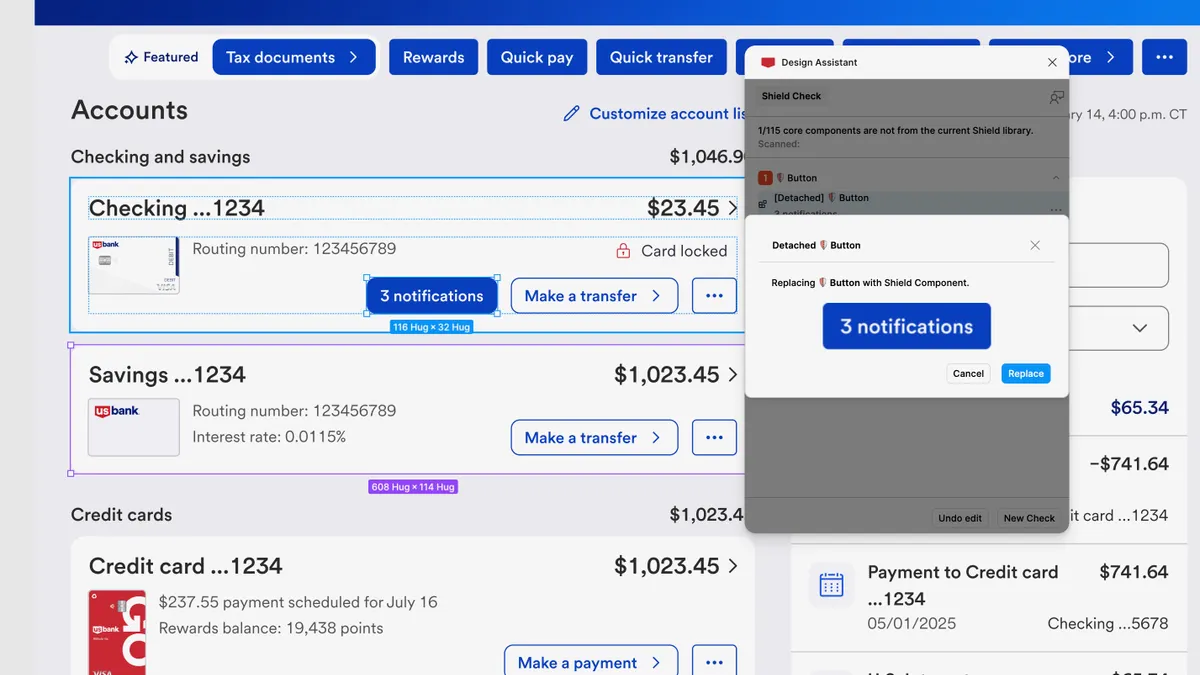
Design Assistant considers the bank’s standards, including brand, content, tonality and accessibility, and connects those to the lender’s design system. As a designer is building a digital experience within Figma, the employee can invoke the tool, which considers what’s been designed and returns a list of things that need to be fixed, Schmidt said.
That might be color contrast, for example, if a label on a button is too difficult for low-vision customers to read. The Design Assistant cites the specific issue and ties it to U.S. Bank’s standards, then gives the designer the option to make a suggested change, Schmidt said.
“The reason we don't do that just automatically, without that human-in-the-loop intervention, is that sometimes those were decisions that were made for a valid reason,” he said. “We want that human check to happen before it automatically fixes something.”
The tool is used for large tasks, such as scouring hundreds of pages built for a brand-new bank experience, and small ones, like optimizing existing pages by moving the location of a button, Schmidt said.
The AI tool is saving designers time, Schmidt said – including hours of back-and-forth between designers and engineers – and ensuring what’s sent from design to engineering is defect-free. It also enables the bank to track where issues are cropping up. Such data could inform future employee training if patterns are observed, Schmidt said.
From an accessibility perspective, U.S. Bank is seeing 30% fewer defects because the tool catches quality issues before heading to the development side, Schmidt said. That’s saving the lender money, too, he said, because it’s more cost-effective to catch those defects earlier in the process.
Designers building the tool for their own use is emblematic of the culture of innovation the bank tries to drive, Schmidt said. “We want to empower our employees across the company to contribute these types of tools,” he said.
U.S. Bank declined to say how much it invested in developing the tool. Return on investment will take some time to measure because it’s only been in heavy use for about one quarter, Schmidt said. But the bank is starting to make some correlations, such as increases in customer satisfaction as the tool has resulted in defect-free experiences.
As the bank refines Design Assistant, “we've got a lot more that we have planned and built into a roadmap,” including integrating more of the bank’s brand standards, he said. Incidentally, U.S. Bank is starting to roll out “a pretty substantial brand refresh” that balances expertise and trust with a premium or sophisticated feel, he said.
Since the lender has done research and testing that found specific patterns or ways of problem-solving methods work better than others, the next layer of value the tool could offer might be proactively surfacing suggestions while a designer is building a flow, Schmidt said.