Tony Sciarrino, head of BMO’s U.S. commercial bank, said he’s on a mission to “make a top-10 bank [into] a top-5 bank.”
Growth in California – where the lender is hiring bankers, building branches and boosting advertising – is a key component of that effort, the Canadian bank conveyed during its investor day in Toronto last week.
Sciarrino, who’s based in California, joined BMO a year ago to lead its commercial bank in the U.S. He spent 27 years at Bank of America in senior commercial banking roles before joining JPMorgan Chase, where he led the largest U.S. lender’s western U.S. commercial banking business.
At Bank of America, Sciarrino worked with Aron Levine, who jumped to BMO in mid-2025 to become the bank's U.S. president.
Sciarrino has overseen BMO’s shift to a unified commercial bank model, pairing local delivery with product and advisory expertise, which he contends is different from other banks.
BMO “eliminate[s] a lot of the internal silos that I've seen in other places,” Sciarrino said during a recent interview. He pointed to the lender’s integrated middle-market investment bank, which has about 80 employees reporting to him.
BMO’s U.S. commercial bank serves about 22,000 clients generating between $10 million and $2 billion in revenue annually. The segment is responsible for about 55% of BMO’s U.S. revenue, and comprises 47% of deposits and 70% of loans, according to investor day materials.
BMO, whose U.S. operations are based in Chicago, aims to drive commercial revenue by deepening relationships with existing clients, lining up new ones and pushing its treasury, payments and capital markets services, Levine said during the March 26 investor day.
The bank’s U.S. commercial segment has about 800 bankers, with about 50 hired in recent months, Levine said.
As for further hiring, BMO aims to boost its banker headcount to 960 by fiscal 2028, and “80% of future hires will be in California, where we aim to become a leading player in commercial banking, just like we are in the Midwestern markets,” Levine said during investor day.
Sciarrino noted the bank is hiring a U.S. middle-market leader who will report to him and Carrie Cook, global head of investment and corporate banking. The bank plans to continue to invest in talent as it realizes efficiencies through artificial intelligence tools, he said.
The bank is also bolstering its California branch count, from 220 to 360, Levine said.
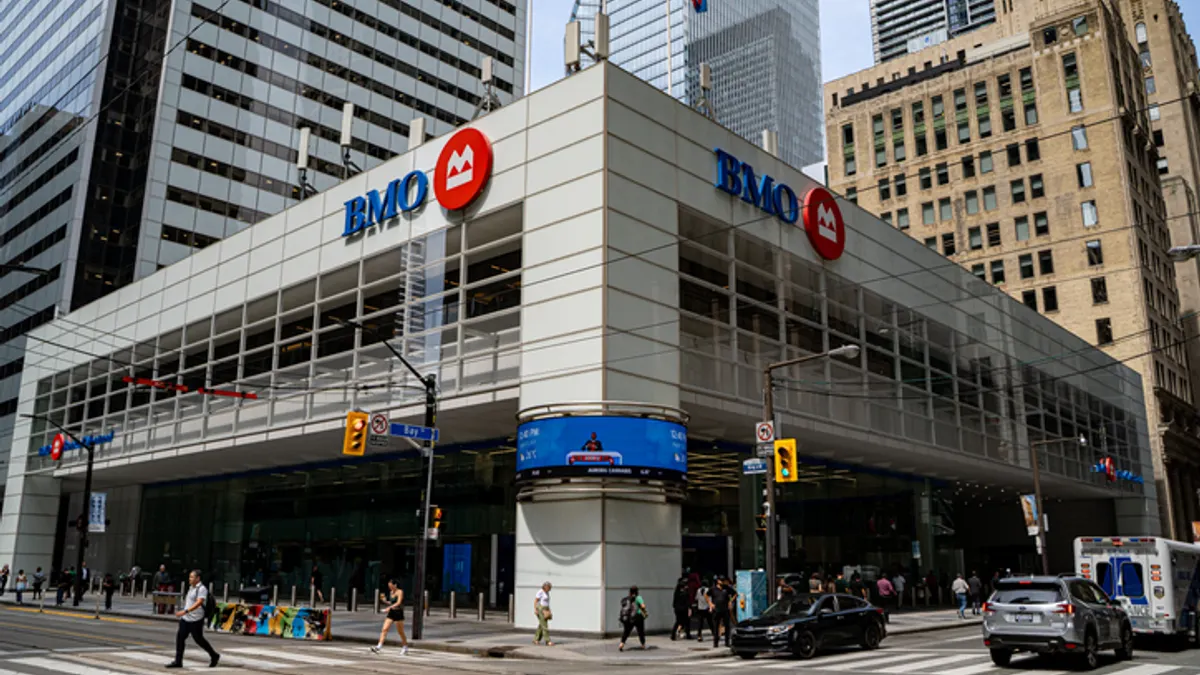
BMO’s U.S. presence grew dramatically with its 2023 purchase of Bank of the West, the U.S. retail arm of French lender BNP Paribas. That deal gave BMO its foothold in the San Francisco and Los Angeles markets.
BMO’s branch and hiring plans in California “replicate the Midwest playbook following the Bank of the West acquisition,” Jefferies analyst John Aiken wrote in a recent note.
Sciarrino noted the brand recognition that comes from the branch builds. A billboard in California shown during investor day asserted, “New to California. Not new to banking.”
In two years, brand awareness in the state nearly tripled, and brand consideration among California’s general population went from 11% to 27%, according to investor day materials.
When an analyst asked how the bank can differentiate in California since that’s been a difficult endeavor for the superregionals, Levine pointed to BMO’s industry expertise, treasury platform, capital markets business and the addition of Sciarrino and other talent.
“We can compete with anyone, at any time, across commercial,” he said.
In the fiscal first quarter of 2026, revenue at BMO’s the U.S. commercial bank dropped about 2% year over year, to $1.1 billion.
By investing in talent and technology and promoting its full roster of products and services to its commercial clients, BMO expects to see a mid-single-digit increase in profitable loans and deposits in the medium term, Levine said. Loan growth is projected for the second half of the year.
Those elements are expected to fuel a 10% non-interest revenue growth rate and 12% return on equity that BMO’s U.S. banking segment is targeting in the medium term.
The bank also seeks to increase its commercial treasury and payment solutions penetration, from 57% to 70% in the medium term. BMO has “identified many clients where we know we can capture greater share of wallet,” Levine said.
Sciarrino mentioned one BMO client, an online retailer based in California, for which the bank has discussed developing an employee benefits banking program.
“Products and services will come out of these conversations – how do we offer employee banking programs that are a little bit different?” Sciarrino said. “Employee banking programs and delivering the firm entirely is something that you’ll see us doing more broadly across the U.S.”
The bank has also streamlined account opening and onboarding, and is planning to launch new products tied to its treasury business, Sciarrino said.
BMO is pushing for quick results. “One of the things that we talk about internally is #TNT, which means ‘today not tomorrow,’” and delivering for clients at speed, Sciarrino said.